
https://doi.org/10.53940/reys.v7i13.254
Plagiarism Awareness and Citation Challenges in EFL Dissertation Writing
Conciencia sobre el plagio y desafíos de citación en la redacción de tesis en inglés como lengua extranjera
Hasna Metatha1
https://doi.org/10.53940/reys.v7i13.254
Plagiarism Awareness and Citation Challenges in EFL Dissertation Writing
Conciencia sobre el plagio y desafíos de citación en la redacción de tesis en inglés como lengua extranjera
Hasna Metatha1


Methata, H. (2026 Plagiarism Awareness and Citation Challenges in EFL Dissertation Writing. Revista Educación y Sociedad, 7(13), 55-72. https://doi.org/10.53940/reys.v7i13.254
Artículo recibido: 30-05-2026
Artículo aprobado: 05-08-2026
Arbitrado por pares
Resumen
Plagiarism and citation difficulties remain major challenges in EFL dissertation writing. This study investigates Master 2 EFL students’ awareness and citation practices at a public university in eastern Algeria, using a mixed-methods design combining a questionnaire (n=75) and analysis of 31 dissertations. Findings show that although students understand plagiarism and are somewhat familiar with APA style, they often misapply citation rules, particularly in paraphrasing, formatting, referencing, and source selection. These issues reflect limited guidance and training. The study concludes that awareness should be supported by explicit instruction in citation literacy to strengthen academic integrity.
Palabras clave: plagiarism awareness, citation literacy, EFL students, academic writing
El plagio y las dificultades con las citas siguen siendo retos importantes en la redacción de tesis de inglés como lengua extranjera (EFL). Este estudio analiza la conciencia y las prácticas de citación de los estudiantes de Maestría 2 en EFL de una universidad pública del este de Argelia, utilizando un diseño de métodos mixtos que combina un cuestionario (n = 75) y el análisis de 31 tesis. Los resultados muestran que, aunque los estudiantes comprenden qué es el plagio y están algo familiarizados con el estilo APA, a menudo aplican incorrectamente las reglas de citación, particularmente en la paráfrasis, el formato, las referencias y la selección de fuentes. Estos problemas reflejan una orientación y capacitación limitadas. El estudio concluye que la concientización debe ir acompañada de una instrucción explícita en alfabetización en citación para fortalecer la integridad académica.
Keywords: conciencia sobre el plagio, alfabetización en citación, estudiantes de EFL, redacción académica
1 Lecturer, Department of English, University of Batna 2 (Algeria). h.metatha@univ-batna2.dz https://orcid.org/0009-0008-5073-2812
Introduction
In many EFL (English as a Foreign Language) academic contexts, writing a dissertation is one of the most important and challenging tasks students undertake. It marks a key moment in their academic journey, requiring them to apply what they have learned over the years in a single, extended piece of work. For EFL students, this process is especially demanding, not only because they must express complex ideas in a language that is not their own, but also because they are expected to follow academic conventions that may be unfamiliar to them. Yet, it is through this process that students grow as researchers, thinkers, and communicators (Lopatto, 2004; Lovitts & Wert, 2009; McMillan & Weyers, 2008).
At the core of successful academic writing is the principle of academic integrity, and understanding how to cite sources correctly is a crucial part of this. Proper citation is not just a way to avoid plagiarism; it demonstrates respect for the work of others (Mansourizadeh & Ahmad, 2011), reinforces arguments, and shows that the writer is engaging thoughtfully with existing research (Samraj, 2013; Swales, 2014). However, for many students, particularly those writing in a foreign language, mastering citation can be challenging (Lamptey & Atta-Obeng, 2012; Jomaa & Bidin, 2017; Rabab’ah & Al-Marshadi, 2013). This difficulty often arises from a misunderstanding of what constitutes plagiarism, or from external pressures to succeed, or even a lack of confidence in their own voice and ideas.
Master 2 EFL students at a public university in eastern Algeria, like many of their peers around the world, often struggle with proper citation practices in their dissertations. This has been observed over several years of teaching, supervising, and examining dissertations. While students gradually become more familiar with academic writing, many still face difficulties understanding when and how to cite sources correctly, how to avoid plagiarism, and how to express ideas in their own words. These issues are especially common in EFL contexts, where students write in a foreign language and must follow academic conventions that may be unfamiliar to them. Based on these observations, the present study aims to explore EFL students’ awareness of plagiarism, the main challenges they face in citation, the connection between their plagiarism awareness and citation practices, and possible teaching strategies to support them in this area.
Understanding how EFL students perceive and handle plagiarism and citation is essential for improving the quality of academic writing in higher education. By focusing on the specific experiences of Master 2 EFL students at a public Algerian university, this study seeks to shed light on common gaps in knowledge and practice. The insights gained can inform more effective pedagogical approaches and academic support, helping students not only to meet academic standards but also to develop stronger, more ethical writing habits that will serve them in both academic and professional contexts.
Literature Review
Plagiarism Awareness in EFL Education
Plagiarism, a term derived from the Latin plagiarius, originally meant “kidnapper, seducer, or plunderer” (Harper, 2001). Over time, it was metaphorically extended to signify the unauthorized appropriation of another’s words or ideas when the Roman poet Martial used it to refer to Fidentinus for copying some of his poetry without credit in the first century (Lubell, 2020). The term entered the English language around 1600, initially as plagiary and later as plagiarism, marking the start of its definition as “the action or practice of taking someone else’s work, idea, etc., and passing it off as one’s own; literary theft” (Oxford English Dictionary, 2023, plagiarism entry). This linguistic evolution reflects a persistent negative connotation, framing plagiarism as a serious ethical breach and a form of intellectual theft; an understanding that continues to inform contemporary academic policies.
Historically, the conceptualization of plagiarism as a moral and legal offense developed alongside the evolution of copyright and authorial rights. The presentation of the first English copyright law in 1709 primarily aimed to protect publishers from piracy. However, as Bhattathiripad (2014) observes, this focus rapidly expanded to encompass the rights of authors themselves, emphasizing the emerging value of individual intellectual ownership. Influential legal and literary figures, such as James Boswell, biographer of Samuel Johnson, played pivotal roles in extending copyright protections, advocating for longer durations of legal ownership for authors and their heirs (Tarisayi, 2025). This trajectory laid the foundation for contemporary definitions of plagiarism, which now go beyond academic etiquette and are viewed as violations of intellectual property and scholarly integrity.
In today’s academic environment, plagiarism is generally understood as the use of another’s intellectual output, be it textual, visual, or auditory, without proper attribution. While this offense is widely condemned across scholarly communities, it is not always committed intentionally. Particularly in Foreign Languages education settings, students may plagiarize unknowingly due to unfamiliarity with citation norms, limited linguistic resources, or differing cultural conceptions of authorship (Şimşek, 2024). Therefore, plagiarism awareness has become a critical educational objective in foreign languages instruction in general and EFL education in particular. Teaching students how to paraphrase, summarize, and properly credit sources is essential not only for academic success but also for fostering ethical research habits and respect for intellectual property.
The rise of digital resources and generative technologies, particularly AI tools, has significantly complicated traditional understandings of originality and authorship, hiding the lines between independent thought and derivative content. These developments challenge existing academic integrity norms, which often remain rooted in early modern conceptions of plagiarism as mere "theft" (Tarisayi, 2025). As AI-generated content becomes more prevalent, scholars emphasize the need for a broader, more adaptive understanding of plagiarism; one that reflects both technological shifts and evolving notions of intellectual authorship. In response, Tarisayi (2025) proposes a comprehensive framework that integrates the social construction of technology with legal perspectives, highlighting the urgency for updated pedagogical and institutional strategies that address the complexities of authorship in the digital age.
The social construction of technology theory, as discussed in Hall (2020) and Song (2021), views technological developments as deeply intertwined with societal values and practices. This perspective emphasizes that technologies such as AI do not merely exist as neutral tools but are actively shaped by the context in which they are used, which in turn shapes how plagiarism is understood in academic contexts. In this sense, plagiarism is no longer confined to the direct copying of text, but extends to the unacknowledged use of AI-generated ideas or phrasing, challenging conventional academic integrity standards.
On the legal front, the framework incorporates insights from Kendal (2022), emphasizing the need to examine how current university policies define and regulate plagiarism in relation to AI. Tarisayi (2025) notes that many institutional policies remain grounded in a seventeenth-century conception of plagiarism as theft, and often fail to account for new forms of authorship facilitated by AI. This includes evaluating how copyright, intellectual property rights, and fair use are interpreted in academic contexts where AI-generated content is increasingly present.
By integrating both social and legal dimensions, Tarisayi (2025) provides a nuanced understanding of plagiarism as a dynamic and evolving concept. This approach underscores the importance of redefining plagiarism in a way that reflects contemporary technological advancements, ensuring that academic policies can adapt to new challenges in upholding integrity. In doing so, it supports the development of clearer, more robust frameworks for upholding academic integrity in the digital age.
As the conceptualization of plagiarism evolves, so too does the need for a deeper understanding of citation practices among students, as citation remains the primary means by which academic integrity is upheld and plagiarism is avoided. While raising plagiarism awareness promotes ethical research behaviours, citation literacy continues to be a critical yet often neglected component of EFL instruction (Childers & Bruton, 2016). Students who struggle to distinguish between common knowledge and information requiring citation are especially vulnerable to unintentional plagiarism. This gap highlights the urgent need to explicitly teach citation literacy; an essential skill that not only safeguards academic integrity but also enhances students' capacity to engage responsibly with source material in their writing.
Citation Literacy: A Missing Skill?
Citation literacy refers to the ability to understand, interpret, and apply citation practices accurately within academic writing (Chew, 2018a). It encompasses not only the technical aspects of formatting citations according to specific styles (such as APA, MLA, or Chicago) but also the ethical and rhetorical considerations involved in acknowledging the intellectual contributions of others (Mansourizadeh & Ahmad, 2011). This proficiency enables writers to integrate sources effectively, distinguishing between their own ideas and those derived from existing literature, thereby maintaining academic integrity and avoiding plagiarism.
Citing sources is not merely a formal requirement; it is a fundamental practice that supports academic integrity and scholarly communication (Divecha et al., 2023; Mott & Cockayne, 2017; Ngatuvai et al., 2021). Proper citation shows that a writer’s work is based on credible evidence and acknowledges the contributions of others. This transparency allows readers to trace the origins of ideas and verify information, which strengthens the trustworthiness and reliability of academic writing (Schmied, 2018). By clearly indicating where information comes from, citations help maintain honesty in scholarly work and promote a culture of mutual respect in the academic community.
Citing sources is an essential part of academic writing that goes beyond simply giving credit; it adds value to a writer’s work by placing new ideas within a broader research context (Petrić & Harwood, 2023; Samraj, 2013). Acknowledging the contributions of other scholars shows that the writer is aware of previous studies and is building on an existing body of knowledge (Lipson, 2011). For instance, in EFL education, referencing key research on language learning or classroom strategies not only strengthens the writer’s argument but also demonstrates thoughtful engagement with the field. Citation also plays a key role in avoiding plagiarism, helping writers clearly separate their own ideas from those taken from other sources. Proper citation practices protect writers from these risks while supporting academic honesty (Kashkur et al., 2010). Moreover, citing credible, well-respected sources lends authority to the writing and makes arguments more convincing by showing they are based on solid evidence (Hewings et al., 2010; Petrić & Harwood, 2023; Samraj, 2013; Swales, 2014; Thompson & Ye, 1991). In scientific writing, this might mean referencing clinical studies; in history, it could involve citing archival materials—either way, sources help turn opinions into well-supported claims. Citations also serve as useful tools for readers, pointing them toward further reading or deeper analysis, which encourages continued learning and engagement (Damarell et al., 2005). As Lipson (2006) notes, citation not only gives credit but also shows what the writer knows and helps readers find reliable sources for their own work. Ultimately, by citing sources accurately, writers contribute to the academic community, promote transparency, and support the ongoing development of knowledge, all while avoiding potential legal or institutional consequences related to copyright infringement.
Numerous studies have highlighted the challenges students face with citation practices in academic writing, particularly among non-native English writers. These challenges often stem from a lack of awareness and training in citation techniques, which can lead to misunderstandings and even academic misconduct, such as plagiarism. Rabab’ah and Al-Marshadi (2013) examined the citation practices of Arab EFL learners and native speakers, finding that nonnative writers were more likely to use integral-verb and non-integral citations, while native writers favoured noun-phrase citations. This suggests that non-native writers, particularly those whose first language is not English, face difficulties in mastering diverse citation styles, which are essential for academic writing.
A similar study by Lamptey and Atta-Obeng (2012) focused on postgraduate students at a Ghanaian university, revealing that students struggled with the complexities of citation styles. Many students relied heavily on external sources of help, such as books, lecturers, or librarians, and often could not confidently identify the citation format they were using. This reliance on external support further emphasizes the difficulty these students have in mastering citation formats independently. Similarly, Jomaa and Bidin (2017) found that Arab doctoral students in Malaysia encountered specific challenges when integrating sources into their literature reviews. These challenges included issues such as addressing the credibility of sources, a lack of knowledge on how to use citations, and language barriers. These studies highlight a common theme: many students lack the necessary citation skills to integrate sources effectively and accurately into their academic work.
Another recurring issue in these studies is the tendency of students to over-rely on certain citation types, such as integral citations. Jalilifar and Dabbi (2013) found that Iranian MA students frequently used integral citations, embedding authors' names directly within the main text, instead of diversifying their citation practices. Similarly, Nguyen and Pramoolsuk (2016) studied the citation practices of Vietnamese TESOL students and observed a preference for integral citations, but with a limited range of citation functions. This narrow use of citation techniques suggests that students are often aware of one type of citation but struggle to apply others appropriately. Rezeki (2018) found similar patterns in Indonesia, where non-integral citations were the most commonly used. The consistent overuse of certain citation types across different countries reflects a gap in students' understanding of the full range of citation methods available to them.
The lack of understanding and the over-reliance on basic citation techniques often lead to students failing to engage critically with their sources. Gullifer and Tyson (2010) explored students' views on plagiarism and found that many students were confused about what constitutes plagiarism due to unclear institutional guidelines. In a follow-up study, Gullifer and Tyson (2010) confirmed that most students were not familiar with their university’s plagiarism policies. This lack of clarity further exacerbates the challenges students face in avoiding academic misconduct. These findings emphasize the need for clearer guidelines and more formal instruction on citation practices to help students avoid unintentional plagiarism and improve their academic writing.
To address these challenges, a growing body of literature has emphasized the importance of systematic citation instruction integrated into EFL curricula. Manan and Noor (2015) suggested incorporating research methodology training to help students effectively use integral citations. Nguyen and Pramoolsuk (2016) also advocated for more formal instruction in academic writing, focusing on teaching students not only how to cite sources properly but also understanding the rhetorical functions and effects of citations in academic work. Such training would be crucial for ensuring that students are equipped to navigate the complexities of citation practices and contribute meaningfully to the academic community.
In the Algerian EFL context, no prior research has specifically addressed the common citation mistakes committed by students in their dissertation writing. The only study found on this topic was conducted at Mohammed Seddik Benyahia University, Jijel, where Bougherza and Azieb (2023) analysed eight Master’s dissertations and found a preference for non-integral over integral citations. The difficulty with integral citations was linked to limited writing skills and a lack of communicative competence. The study concluded that relying solely on citation guidelines is insufficient and recommended integrating targeted citation training and practical exercises into academic writing and English for Academic Purposes (EAP) courses to improve students’ citation practices.
Building on this, the present study aims to investigate the most common citation mistakes made by an Algerian public university EFL students in their Master’s dissertation writing. Its objective is to identify frequent errors that impede proper source use and attribution. The significance of this research lies in its potential to inform teaching strategies, improve academic writing instruction, and help students avoid plagiarism by strengthening their citation competence.
Methodology
Research Design
This study adopted a mixed-methods approach to investigate plagiarism awareness and citation practices among Master 2 EFL students at a public university in eastern Algeria, with particular attention to dissertation writing. The study combined quantitative data obtained from an electronic questionnaire with qualitative coding and descriptive frequency data derived from the systematic analysis of students’ Master’s dissertations. The questionnaire was used to examine students’ reported awareness and understanding of plagiarism and citation practices, whereas the documentary analysis was used to identify, classify, and quantify common citation problems in students’ actual dissertation writing. This complementary design provided a broader understanding of both students’ reported awareness and their demonstrated source-use practices. More specifically, the study aimed to assess students’ awareness of plagiarism, identify the main citation problems occurring in their dissertations, examine the extent to which reported awareness corresponded with actual citation practices, and draw pedagogical implications for strengthening citation literacy and academic integrity in EFL academic writing.
Participants and Documentary Sample
The participants were Master 2 EFL students enrolled at a public university in eastern Algeria during the 2024–2025 academic year. A total of 247 students from three specialties—Didactics (N = 102), Language and Culture (N = 84), and Language and Applied Linguistics (N = 61)—were invited to participate in the questionnaire component of the study. Although the questionnaire was distributed to all 247 students, 75 completed responses were obtained, representing a response rate of 30.36%. Accordingly, the effective questionnaire sample consisted of 75 student respondents from the three specialties.
The documentary analysis component involved 31 Master’s dissertations selected from a total of 103 dissertations submitted across the three specialties. The number of dissertations was lower than the number of students because students were permitted to write their dissertations in pairs and, occasionally, in groups of three. The 103 dissertations comprised 41 dissertations from Didactics, 26 from Language and Applied Linguistics, and 36 from Language and Culture. To ensure proportional representation across the three specialties, stratified random sampling was employed. The dissertation population was first divided into three strata according to specialty, after which dissertations were randomly selected from each stratum in proportion to its representation in the overall population. The final documentary sample comprised 12 dissertations from Didactics, 8 from Language and Applied Linguistics, and 11 from Language and Culture, representing approximately 30% of the total dissertation population.
The questionnaire and documentary samples served different purposes and were therefore treated as separate units of analysis. The questionnaire data reflected students’ reported awareness and perceptions, whereas the dissertation analysis provided evidence of their actual citation practices. Given the descriptive and exploratory nature of the study, the questionnaire findings were interpreted primarily through frequencies and percentages rather than inferential statistical testing. The response rate and sampling procedures are reported transparently to indicate the scope and limitations of the findings.
Instruments
Two main sources of data were used: a researcher-developed questionnaire and documentary analysis of students’ dissertations.
Questionnaire
The questionnaire was developed by the researcher to investigate students’ awareness of plagiarism, familiarity with citation styles, citation practices, and the challenges they encounter when citing sources in dissertation writing. It consisted of six sections: (1) demographic information; (2) awareness of plagiarism; (3) familiarity with citation styles; (4) citation practices in dissertation writing; (5) challenges encountered when citing sources; and (6) institutional support and awareness of plagiarism policies. The questionnaire contained both closed-ended and open-ended items. The closed-ended items included five-point Likert-scale questions, while the open-ended items were included to obtain additional qualitative information about students’ experiences and perceptions.
Regarding the quality of the instrument, the questionnaire was subjected to preliminary piloting and expert review rather than statistical validation. Prior to its full administration, it was piloted with a small group of students to assess the clarity and comprehensibility of the items and to identify any ambiguous or difficult-to-understand questions. In addition, two EFL methodology instructors reviewed the questionnaire to assess the clarity and relevance of its items in relation to the objectives of the study. Feedback obtained from both the pilot participants and the expert reviewers was taken into consideration, and the questionnaire was refined accordingly before its final administration. No statistical reliability coefficient was calculated; therefore, the study does not claim statistical evidence of the questionnaire’s internal consistency.
Following this preliminary validation process, the questionnaire was administered electronically through Google Forms and shared via the department’s official Facebook page, making it accessible to Master 2 students across the three specialties.
Dissertation Analysis
The second source of data consisted of 31 Master’s dissertations. The dissertations were examined to identify recurring citation problems, with particular attention to citation accuracy, formatting, paraphrasing, quotation practices, and reference-list accuracy and consistency.
A coding scheme was developed to systematically categorize the citation problems identified in the dissertations. The principal categories were as follows:
· CI-A (Citation Inaccuracy): incorrect or inconsistent author names, publication dates, or source titles in in-text citations and/or reference lists.
· CF-IS (Citation Formatting–Inconsistent Style): inconsistent application of citation conventions, including mixing citation styles or failing to observe formatting requirements such as punctuation, italics, and page numbers in direct quotations.
· QR-O (Quotation Referencing–Overuse or Omission): excessive reliance on direct quotations and/or omission of quotation marks or page numbers where required.
· P-IP (Paraphrasing–Improper or Plagiarized): paraphrased material that remained too close to the original wording, lacked appropriate citation, or inaccurately represented the source.
· B-MI (Bibliography–Missing or Incomplete): reference-list entries that were missing or lacked essential bibliographic information.
· B-DM (Bibliography–Disconnected or Mismatched): discrepancies between in-text citations and the reference list, including cited works that were absent from the reference list and listed works that were not cited in the text.
Additional citation problems, including misuse of et al., citation of non-academic sources, and failure to acknowledge the sources of visuals and data, were also recorded.
Data Collection Procedure
Data collection was conducted during the 2024–2025 academic year. The questionnaire was distributed electronically to all 247 Master 2 students enrolled in the three EFL specialties. It was made available to students from March 10 to April 15, 2025. Participation was voluntary, and students were invited to complete the questionnaire electronically during this period. A total of 75 completed questionnaires were received, representing a response rate of 30.36%. Only completed questionnaires were retained for analysis.
For the documentary component, 31 Master’s dissertations were selected from the 103 dissertations submitted across the three EFL specialties. Stratified random sampling was used to ensure proportional representation of the three specialties. The selected dissertations were systematically examined using the predefined coding categories. Instances of citation problems were identified, classified according to the established coding scheme, and recorded for subsequent analysis.
The two data sources were treated as complementary. The questionnaire provided information about students’ reported awareness and understanding of plagiarism and citation practices, whereas the documentary analysis provided evidence of citation practices as reflected in students’ actual dissertation writing. The questionnaire data were analysed primarily through frequencies and percentages, while the documentary data were analysed by recording and quantifying the citation problems identified according to the predefined coding categories. This combination enabled the study to examine both students’ reported awareness and their actual citation practices.
Ethical Considerations
Participation in the questionnaire component of the study was voluntary. Participants were informed of the purpose of the study and that the information collected would be used for research purposes. No personally identifying information was requested through the questionnaire, and participants’ responses were treated confidentially. Participants were free to decide whether to participate in the study.
For the documentary component, the dissertations were examined solely for the purpose of investigating students’ citation practices. The analysis focused on citation patterns and problems rather than on identifying or evaluating individual students. The dissertation data were treated confidentially throughout the analysis and reporting process.
To ensure institutional anonymity, the name of the university has been omitted from the manuscript. As mentioned earlier, the study was conducted at a public university in eastern Algeria during the 2024–2025 academic year.
Data Analysis
The quantitative component of the study consisted primarily of the analysis of responses to the closed-ended questionnaire items. The responses were summarized using descriptive statistics, particularly frequencies and percentages, to identify patterns in students’ awareness of plagiarism, familiarity with citation styles, citation practices, perceived challenges, and awareness of institutional support.
The qualitative component comprised the open-ended questionnaire responses and the analysis of citation problems identified in the dissertation sample. The open-ended responses were examined to identify recurring perceptions and experiences related to plagiarism and citation. The dissertation data were analysed through the coding scheme described above, and the frequency and distribution of the identified citation problems were examined across the three specialties.
The two sources of data were considered together to provide a more comprehensive interpretation of students’ citation practices. The questionnaire data provided information about students’ reported awareness, practices, and perceptions, whereas the dissertation analysis provided evidence of citation practices as manifested in their actual academic writing.
Taken together, the methodological components described above illustrate how the quantitative and qualitative dimensions of the study were combined to address its research objectives. For greater clarity, Table 1 summarizes the main methodological features of the study.
Table 1
Methodological Overview of the Study
|
Component |
Quantitative Component |
Qualitative/Documentary Component |
|
Participants/ Data sources |
75 Master 2 EFL students |
31 Master’s dissertations |
|
Population |
247 Master 2 students |
103 submitted dissertations |
|
Sampling |
Questionnaire distributed to the entire student population; 75 valid responses obtained |
Stratified random sampling |
|
Instrument/ Data source |
Researcher-developed questionnaire |
Dissertation analysis and coding scheme |
|
Main focus |
Plagiarism awareness, citation-style familiarity, citation practices, challenges, and institutional support |
Citation accuracy, formatting, quotation, paraphrasing, bibliography, and source attribution |
|
Data type |
Closed-ended and open-ended questionnaire responses |
Coded instances of citation problems |
|
Analysis |
Frequencies and percentages |
Coding, frequencies, and comparison across specialties |
Results
The results are presented in two parts: first, the findings from the questionnaire on plagiarism awareness and citation practices, followed by the document analysis of citation issues in students’ dissertations.
Questionnaire Results
The results obtained from the questionnaire reveal several key trends in the participants' academic writing experiences and their awareness of plagiarism and citation practices.
Demographic Information
The demographic data from the questionnaire provide valuable insights into the background and academic experience of the participants. The majority of participants (71.1%) were enrolled in the Language and Culture (LC) specialization, followed by 15.6% in Language and Applied Linguistics (LAL), and 13.3% in Didactics (DID). All students (100%) identified Arabic as their first language. However, this likely reflects a misunderstanding of the term “first language,” as many may have interpreted it to mean Arabic in its general or official form (Modern Standard Arabic), rather than their actual mother tongue. Notably, no respondent mentioned Chaoui as a first language, even though the region is predominantly Chaoui-speaking. This suggests that students may not have understood the question as referring to their native or home language. In terms of multilingualism, students reported speaking additional languages such as Spanish, Chaoui, French, Turkish, Japanese, and Italian. When asked whether they had taken any university courses focused on academic writing, 73.3% answered ‘yes’ and 26.7% ‘no’. The courses cited included research methodology, written expression, academic writing, and thesis writing. Regarding citation instruction, 66.66% indicated they had been taught APA style, while the remainder reported familiarity with both APA and MLA styles.
Understanding of Plagiarism
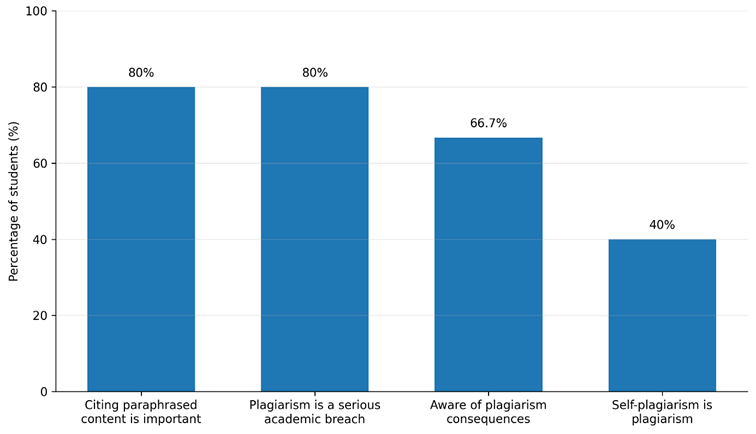
The results from Section 2 of the questionnaire indicate a generally strong understanding of plagiarism among students. Most respondents (80%) acknowledge the importance of citing paraphrased content, though some remain uncertain. Opinions on self-plagiarism are divided, with 40% agreeing that resubmitting previous work is plagiarism, while 20% disagree. The belief that minor wording changes avoid plagiarism was met with mixed responses, with many neutral or unsure.
Regarding common knowledge, 33.3% were neutral, and 26.7% believed it does not need citation, highlighting some confusion. Most students (66.7%) are aware of the consequences of plagiarism, although a few are less informed. Finally, 80% agree that plagiarism is a serious academic breach, reflecting strong ethical awareness. Figure 1 summarizes selected findings on students’ awareness of plagiarism and highlights the contrast between their generally strong awareness and their uncertainty about specific aspects of plagiarism.
Figure 1
Students’ Awareness of Plagiarism
Knowledge of Citation Styles
The results from Section 3 indicate varying levels of familiarity with citation styles. APA is the most recognized, with 46.7% of students reporting familiarity, followed by 20% who are moderately familiar, 13.3% slightly familiar, and 13.3% very familiar. In contrast, 40% are not familiar with MLA, while familiarity with Chicago is particularly low, with 66.7% reporting no knowledge of it. No respondents indicated familiarity with other citation styles. Overall, while APA is the most commonly known style, there are considerable gaps in knowledge of MLA and Chicago formats.
Citation Practices in students’ Dissertation
The results from Section 4 on citation practices in students' dissertations reveal a variety of approaches to citation. A clear majority (80%) primarily used APA style, while 6.66% used MLA, and another 6.66% reported not using a citation style at all. Additionally, 6.66% indicated they relied on direct verbatim citations, which likely reflects a misunderstanding of the question, as they may have confused the concept of citation practices with citation styles.
Regarding the frequency of consulting citation guides, 33.3% of students did so sometimes, 26.7% rarely, 20% often, 13.3% never, and the remaining respondents always consulted a citation guide.
In terms of tools used to assist with citations, 33.3% did not use any tools, while another 33.3% relied on online citation generators and 33.3% used print citation guides. Additionally, 26.7% utilized citation management software, 26.7% used plagiarism detection software, and 13.3% referred to resources provided by the university.
When paraphrasing or summarizing information from a source, 33.3% of students always double-checked that they had provided a correct citation, 26.7% did so often, 20% rarely, and 13.3% sometimes, while the remaining respondents never checked.
Finally, regarding confidence in the accuracy of their citations, 46.7% of students reported being moderately confident, 26.7% were confident, 20% were very confident, and the rest were slightly confident. Overall, the results suggest that while students generally approach citation practices thoughtfully, there are areas where further clarity and improvement could be beneficial.
Challenges with Citation in Students’ Dissertation Writing
The findings from the section on challenges with citation in students’ dissertation writing highlight several areas of difficulty. More than half of the respondents (53.3%) agreed that applying specific rules of a citation style was challenging, and 46.7% reported struggling to paraphrase effectively without plagiarizing, with many others remaining neutral on both issues. Determining the appropriate level of detail in a citation was also uncertain for many, as 60% responded neutrally and 33.3% agreed it was a challenge.
Tracking sources posed another issue, with 53.3% expressing neutrality and only 13.3% agreeing it was difficult, while a quarter disagreed. English language proficiency also played a role, with 46.7% neutral and an equal share (26.7%) agreeing and disagreeing on its impact. Confidence in using citation management software was mixed: 40% were neutral, 33.3% agreed they lacked confidence, and 26.7% disagreed.
Additionally, 40% felt they did not receive enough guidance from their supervisors on correct citation practices, and time constraints emerged as a notable challenge, with 33.3% agreeing that limited time affected citation accuracy. These results indicate that while some students manage citation tasks with relative ease, many face ongoing struggles with rules, paraphrasing, language use, and guidance. Figure 2 summarizes the main citation-related challenges reported by the students and highlights the relative prevalence of these difficulties.
Figure 2
Students’ Reported Challenges with Citation

Plagiarism Policy and Support at students’ University
The results concerning plagiarism policy and support at the students' university indicate notable gaps in awareness and consistency of support. When asked whether their university has a clearly defined plagiarism policy communicated to students, 40% stated they did not know, 33.3% said yes, and the rest responded negatively—suggesting a lack of clear communication on institutional policies. However, a strong majority (73.3%) confirmed receiving training or workshops on how to avoid plagiarism during their Master’s studies. Among those who participated, perceptions of the training’s effectiveness varied: 33.3% found it moderately helpful, while equal percentages rated it as not helpful, helpful, or very helpful.
Most respondents (73.3%) agreed that their university provides adequate resources and support for correct citation, yet their suggestions point to a desire for improvement. Recommendations included the adoption of updated plagiarism detection tools, more specialized and mandatory workshops on academic integrity, interactive sessions, personalized consultations, and curriculum integration of citation and plagiarism awareness. Students also suggested regular practice sessions, use of citation tools during drafting, and one-on-one writing support to better equip Master’s level EFL writers in avoiding plagiarism and citing sources effectively.
Document Analysis Results
The following table presents a summary of the citation issues identified during the document analysis of 31 dissertations across the three specialties. The table categorizes the observed citation problems using a coding scheme designed to highlight common errors in citation accuracy, formatting, paraphrasing, and bibliography management. Each row in the table corresponds to a specific citation issue, and the columns provide the distribution of these issues across the three specialties, offering insights into the patterns and challenges students face in adhering to academic citation standards.
Table 2
Document Analysis Summary of Citation Issues with Coding Scheme
|
Citation Issue |
Didactics (n=12) |
Lang. & Applied Linguistics (n=8) |
Lang. & Culture (n=11) |
Total (n=31) |
|
CI-A (Citation Inaccuracy) |
42 (8.97%) |
28 (9.09%) |
50 (10.72%) |
120 (9.66%) |
|
CF-IS (Citation Formatting – Inconsistent Style) |
106 (22.64%) |
74 (24.02% |
98 (21.03%) |
278 (22.38%) |
|
QR-O (Quotation Referencing – Overuse or Omission) |
70 (14.95%) |
46 (14.93%) |
58 (12.44%) |
174 (14.00%) |
|
P-IP (Paraphrasing – Improper or Plagiarized) |
50 (10.68%) |
32 (10.38%) |
50 (10.72%) |
132 (10.62%) |
|
B-MI (Bibliography – Missing or Incomplete)
|
74 (15.81%) |
48 (15.58%) |
72 (15.45%) |
194 (15.61%) |
|
Citation Issue |
Didactics (n=12) |
Lang. & Applied Linguistics (n=8) |
Lang. & Culture (n=11) |
Total (n=31) |
|
B-DM (Bibliography – Disconnected or Mismatched) |
48 (10.25%) |
32 (10.38%) |
44 (9.44%)) |
124 (9.98%) |
|
Misuse of "et al." |
26 (5.55%) |
16 (5.19%) |
24 (5.15%) |
66 (5.31%) |
|
Citation of Non-Academic Sources |
30 (6.41%) |
18 (5.84%) |
54 (11.58%) |
102 (8.21%) |
|
Absence of Attribution for Visuals and Data |
22 (4.70%) |
14 (4.54%) |
16 (3.43%) |
52 (4.18%) |
The analysis of the table reveals several notable patterns. The most frequent citation issue across all three specialties is Citation Formatting – Inconsistent Style (CF-IS), representing 22.38% of all recorded errors. Students frequently failed to follow APA formatting rules, leading to inconsistencies in punctuation, italics, and author-date formatting. For example, one student cited:
“(Richards and Rodgers 2001)” instead of the correct APA format: (Richards & Rodgers, 2001).
Such inconsistencies were observed in both in-text citations and the reference list, with frequent mixing of styles (e.g., combining APA with MLA elements).
The second most common issue is Bibliography – Missing or Incomplete (B-MI), accounting for 15.61% of the total. These errors were consistent across all three specialties. Typical cases included missing details such as publisher names, places of publication, or journal issue numbers. For instance, a reference entry read:
“Ur, P. (1996). A course in language teaching.” omitting the full citation:
Ur, P. (1996). A course in language teaching: Practice and theory. Cambridge: Cambridge University Press.
This kind of incomplete reference makes it hard to find the source and does not follow academic rules.
Quotation Referencing – Overuse or Omission (QR-O) was the third most frequent error type (14.00%). Students often inserted direct quotations without quotation marks or proper page numbers. For example, one extract stated:
“According to Harmer (2007), motivation is a key factor in language learning.”
without providing quotation marks or a page number, even though the phrase matched the original source closely. This creates confusion about whether the content is quoted or paraphrased and may unintentionally constitute plagiarism.
Paraphrasing – Improper or Plagiarized (P-IP) occurred in 10.62% of cases. This involved content that was either too close to the original wording or lacked a citation altogether. In one instance, a student wrote:
“Language learning is a natural process where the learner imitates and absorbs the language environment,”
This sentence is very similar to a textbook definition but has no citation. Such mistakes show that the student may not know how to paraphrase correctly or when to cite a source.
Disconnected or Mismatched Bibliography Entries (B-DM), comprising 9.98% of issues, were also prevalent. These occurred when in-text citations did not match any source in the reference list. For example, a citation such as:
“(Peterson,2004)”
was found in the body of the dissertation but no corresponding entry appeared in the references. On the other hand, some sources were listed in the references but not mentioned in the text, showing weak citation and referencing skills.
Additional problems included the misuse of “et al.” (5.31%), where students incorrectly used it for two-author works or failed to apply it after the first mention of multi-author sources. For example, citing:
“(Brown et al., 2002)”
on the first mention of a two-author work is incorrect under APA guidelines.
The citation of non-academic sources (8.21%) was more common in Language and Culture dissertations (11.58%), where students frequently referenced definitions or ideas from websites such as Wikipedia or online dictionaries. One student, for instance, included:
“Culture is defined as a shared set of beliefs (Wikipedia, 2023),”
without critically evaluating the reliability of the source or supporting it with scholarly literature.
Finally, Absence of Attribution for Visuals and Data (4.18%) was noted in cases where figures or tables were inserted without indicating their source or authorship. For example, a student presented a chart titled “Levels of Motivation” without clarifying whether it was original, adapted, or reproduced from an external study. In academic research, even self-created visuals based on data from literature require attribution to maintain transparency.
The results from both the questionnaire and the document analysis show that many EFL Master’s students at the university need more help with academic writing. Even though most students know that plagiarism is wrong and try to use citations, they still face problems. These include not following citation styles correctly (especially APA), leaving out important details in reference lists, and not being sure when to quote or paraphrase. Some students also use unreliable websites as sources or include visuals (like charts or graphs) without saying where they came from. These problems show that many students do not fully understand how to use and cite sources properly.
These mistakes are not just individual errors; they show bigger problems in how students are taught, guided, and supported. Many students not only lack the technical skills to cite properly but also the confidence and awareness to use sources in a clear and honest way. To fix this, universities should take action on several levels: they need to create clearer rules about plagiarism, offer hands-on training with citation tools, include more workshops in the curriculum, and make sure supervisors guide students regularly. This is the only way to make sure that avoiding plagiarism becomes a normal and strong part of students’ academic habits.
Conclusions
This study explored plagiarism awareness and citation challenges among Master 2 EFL students at a public university in eastern Algeria, using a questionnaire and document analysis to examine students’ academic writing practices. The findings reveal that, although most students demonstrate a basic understanding of plagiarism and recognize the importance of citation, particularly in relation to APA style, many still experience difficulties in applying citation conventions consistently and accurately in their dissertations. The document analysis further indicates that awareness of plagiarism does not necessarily translate into effective source-use practices, as students continue to experience problems with citation formatting, incomplete references, paraphrasing, and the selection of appropriate academic sources.
These findings are broadly consistent with previous research on plagiarism and citation practices in EFL and higher education contexts. Lamptey and Atta-Obeng (2012) and Jomaa and Bidin (2017), for example, reported that postgraduate students encountered difficulties with citation conventions, source integration, and the appropriate use of academic sources. Similarly, Gullifer and Tyson (2010) found that students’ understanding of plagiarism was affected by limited familiarity with institutional policies and insufficient guidance. The present findings therefore reinforce the view that awareness of plagiarism as an academic offence is not sufficient in itself; students also need the practical knowledge and skills required to use and acknowledge sources appropriately.
The findings also support the conceptualization of citation as an important component of citation literacy rather than simply a matter of following formatting rules. As discussed by Chew (2018b), citation literacy involves the ability to understand and apply citation practices appropriately, while Mansourizadeh and Ahmad (2011) emphasize the ethical and rhetorical dimensions of acknowledging sources. In the present study, students’ difficulties with paraphrasing, incomplete references, inconsistent formatting, and the use of unreliable sources suggest that citation problems extend beyond a lack of knowledge of APA conventions. Rather, they reflect broader difficulties in locating, evaluating, integrating, and acknowledging sources effectively in academic writing. This finding supports Childers and Bruton’s (2016) observation that citation literacy remains an important yet often neglected aspect of academic instruction.
The findings are also consistent with previous research on EFL students’ citation practices. Rabab’ah and Al-Marshadi (2013), Jalilifar and Dabbi (2013), Nguyen and Pramoolsuk (2016), and Rezeki (2018) identified difficulties and limitations in students’ use of citation practices across different EFL contexts. The present study similarly suggests that students may understand the importance of citing sources while still struggling to apply citation conventions effectively in authentic academic writing. This distinction between awareness of citation requirements and the ability to implement them effectively is particularly important in dissertation writing, where students are expected to engage extensively and critically with existing scholarship.
The findings also provide further evidence from the Algerian EFL context and are broadly consistent with Bougherza and Azieb’s (2023) study of Master’s dissertations at an Algerian university. Their findings revealed difficulties in citation practices associated with limited writing skills and communicative competence, and they recommended targeted citation instruction and practical exercises within academic writing and EAP courses. The present study supports these recommendations while extending this line of research by examining students’ plagiarism awareness alongside their actual citation practices in dissertation writing. Taken together, the findings suggest that citation difficulties among Algerian EFL postgraduate students should be addressed as part of a broader development of academic writing and citation literacy.
The findings further indicate that citation difficulties cannot be attributed solely to students’ lack of knowledge. Lack of confidence, limited training, and insufficient or inconsistent guidance may also affect students’ ability to apply citation conventions effectively. This observation is in line with the literature reviewed in this study, which emphasizes the importance of systematic instruction and institutional support. Manan and Noor (2015) and Nguyen and Pramoolsuk (2016), for instance, advocate more formal and systematic instruction that helps students understand not only how to cite sources but also how citations function within academic discourse.
These findings have important pedagogical and institutional implications. Raising students’ awareness of plagiarism alone is unlikely to be sufficient to prevent inappropriate source use. Universities should provide structured, hands-on instruction in citation, paraphrasing, source evaluation, and reference management as part of academic writing and dissertation preparation. Students should also receive clear and consistent guidance from supervisors throughout the writing process and have access to appropriate citation-management tools. In addition, institutional policies concerning plagiarism and academic writing should be communicated clearly so that students understand both what constitutes plagiarism and how responsible source use can be achieved.
Overall, this study demonstrates that citation challenges among Master 2 EFL students are not merely technical problems but reflect broader issues of citation literacy, academic writing development, and institutional support. By confirming patterns identified in previous EFL research while providing further evidence from the Algerian context, the study contributes to the literature on plagiarism awareness and citation practices in EFL academic writing. Ultimately, strengthening citation literacy requires a shift from viewing plagiarism primarily as an academic offence to treating responsible source use as a teachable academic competence. Such an approach can help students develop the knowledge, skills, and confidence required to engage ethically and effectively with sources and to become more independent and responsible members of the academic community.
References
Bhattathiripad, V. P. (Ed.). (2014). Judiciary-friendly Forensics of Software Copyright Infringement. IGI Global.
Bougherza, R., & Azieb, S. (2023). The Use of Integrative and Non-integrative Citations by EFL Graduates at the Algerian University—the Case of Master’s Students. Afak for Sciences, 8(3), 287–296. https://asjp.cerist.dz/en/article/223068
Chew, A. Z. C. (2018a). Citation literacy. Arkansas Law Review, 70(4), 869–900. https://scholarworks.uark.edu/alr/vol70/iss4/2
Chew, F. P. (2018b). Evaluation of the Literacy and Numeracy Screening Program in Three Types of National Primary Schools in Malaysia. Journal of Contemporary Educational Research, 2(5), 9–20.
Childers, D., & Bruton, S. (2016). “Should it Be Considered Plagiarism?” Student Perceptions of Complex Citation Issues. Journal of Academic Ethics, 14(1), 1–17. https://doi.org/10.1007/s10805-015-9250-6
Damarell, R., Badcock, J., & Miller, R. (2005). Author-date (Harvard) Referencing Guide (3rd ed.). Flinders University, School of Nursing and Midwifery.
Divecha, C. A., Tullu, M. S., & Karande, S. (2023). The Art of Referencing: Well Begun is Half Done! Journal of Postgraduate Medicine, 69(1), 1–6. https://doi.org/10.4103/jpgm.jpgm_908_22
Gullifer, J., & Tyson, G. A. (2010). Exploring University Students' Perceptions of Plagiarism: A Focus Group Study. Studies in Higher Education, 35(4), 463–481. https://doi.org/10.1080/03075070903096508
Hall, J. (2020). The Social Construction of Technology. In Relating through Technology (pp. 31–47). Cambridge University Press. https://doi.org/10.1017/9781108629935.003
Harper, D. (2001). Plagiarism. In Online etymology dictionary. https://www.etymonline.com/word/plagiarism
Hewings, A., Lillis, T., & Vladimirou, D. (2010). Who’s Citing Whose Writings? A Corpus-based Study of Citations as Interpersonal Resource in English-medium National and English-medium International Journals. Journal of English for Academic Purposes, 9(2), 102–115. https://doi.org/10.1016/j.jeap.2010.02.005
Jalilifar, A., & Dabbi, R. (2013). Citation in Applied Linguistics: Analysis of Introduction Sections of Iranian Master’s Theses. Linguistik Online, 57(7), 91–104. https://www.redalyc.org/articulo.oa?id=664573517008
Jomaa, N. J., & Bidin, S. J. (2017). Perspectives of EFL Doctoral Students on Challenges of Citations in Academic Writing. Malaysian Journal of Learning and Instruction, 14(2), 177–209. https://doi.org/10.32890/mjli2017.14.2.7
Kashkur, M., Parshutin, S., & Borisov, A. (2010). Research into Plagiarism Cases and Plagiarism Detection Methods. Scientific Journal of Riga Technical University, 138–143. https://www.academia.edu/download/49104623/Research_into_Plagiarism_Cases_and_Plagi20160925-11004-vdjoev.pdf
Kendal, E. (2022). Ethical, Legal and Social Implications of Emerging Technology (ELSIET) Symposium. Bioethics, 19(3), 363–370. https://doi.org/10.1007/s11673-022-10197-5
Lamptey, R. B., & Atta-Obeng, H. (2012). Challenges with Reference Citations among Postgraduate Students at the Kwame Nkrumah University of Science and Technology, Kumasi, Ghana. Journal of Science and Technology (Ghana), 32(3), 69–80. https://doi.org/10.4314/just.v32i3.8
Lipson, C. (2011). Cite Right: A Quick Guide to Citation Styles—MLA, APA, Chicago, the Sciences, Professions, and More. Chicago Guides to Writing, Editing, and Publishing. University of Chicago Press.
Lopatto, D. (2004). Survey of Undergraduate Research Experiences (SURE): First Findings. Cell Biology Education, 3(4), 270–277. https://doi.org/10.1187/cbe.04-07-0045
Lovitts, B. E., & Wert, E. L. (2009). Developing Quality Dissertations in the Social Sciences: A Graduate Student’s Guide to Achieving Excellence. Stylus Publishing.
Lubell, S. (2020). Plagiarism. In M. E. David & M. J. Amey (Eds.), The SAGE Encyclopedia of Higher Education. SAGE Publications. https://doi.org/10.4135/9781529714395
Manan, N. A., & Noor, N. M. (2015). The Use of Integral Citations in Master’s Degree Theses. International Journal of Education and Research, 3(7), 233–246. https://www.ijern.com/journal/2015/July-2015/21.pdf
Mansourizadeh, K., & Ahmad, U. K. (2011). Citation Practices among Non-native Expert and Novice Scientific Writers. Journal of English for Academic Purposes, 10(3), 152–161. https://doi.org/10.1016/j.jeap.2011.03.004
McMillan, K., & Weyers, J. (2007). How to Write Dissertations & Project Reports. Pearson Education Limited.
Mott, C., & Cockayne, D. (2017). Citation Matters: Mobilizing the Politics of Citation toward a Practice of “Conscientious Engagement.” Gender, Place & Culture, 24(7), 954–973. https://doi.org/10.1080/0966369X.2017.1339022
Ngatuvai, M., Autrey, C., McKenny, M., & Elkbuli, A. (2021). Significance and Implications of Accurate and Proper Citations in Clinical Research Studies. Annals of Medicine and Surgery, 72, 102841. https://doir.org/10.1016/j.amsu.2021.102841
Nguyen, T. T. L., & Pramoolsook, I. (2016). Citations in Literature Review Chapters in TESOL Master’s Theses by Vietnamese Postgraduates. GEMA Online Journal of Language Studies, 16(2), 17–32. https://doi.org/10.17576/gema-2016-1602-02
Oxford English Dictionary. (2023). Plagiarism. In OED Online. https://www.oed.com/dictionary/plagiarism_n
Petrić, B., & Harwood, N. (2023). Tracing Changes in the Citing Practices of a Master’s Student: A Longitudinal Case Study. In Teaching and learning Source-based Writing (pp. 27–47). Routledge. https://eprints.bbk.ac.uk/id/eprint/51453
Rabab’ah, G., & Al-Marshadi, A. (2013). Integrative vs. Non-integrative Citations among Native and Nonnative English Writers. International Education Studies, 6(7), 78–87. http://dx.doi.org/10.5539/ies.v6n7p78
Rezeki, Y. S. (2018). Analysis of EFL Students’ Citation Practices and Problems in Academic Writing. International Journal of Educational Best Practices, 2(1), 62–72. https://doi.org/10.31258/ijebp.2.1.62-72
Samraj, B. (2013). Form and Function of Citations in Discussion Sections of Master’s Theses and Research Articles. Journal of English for Academic Purposes, 12(4), 299–310. https://doi.org/10.1016/j.jeap.2013.09.001
Schmied, J. (2018). Credibility in Academic andJournalistic Writing and Beyond. Credibility, Honesty, Ethics, and Politeness in Academicand Journalistic Writing. Cuvillier.
Song, J. (2021). Ethical Adaptation and Legal Regulation of Modern Technology. Cultures of Science, 4(3), 169–178. https://doi.org/10.1177/20966083211053085
Swales, J. M. (2014). Variation in Citational Practice in a Corpus of Student Biology Papers: From Parenthetical Plonking to Intertextual Storytelling. Written Communication, 31(1), 118–141. https://doi.org/10.1177/0741088313515166
Tarisayi, K. S. (2025). Lustre and shadows: Unveiling the Gaps in South African University Plagiarism Policies Amidst the Emergence of AI-generated Content. AI and Ethics, 5, 245–251. https://doi.org/10.1007/s43681-023-00333-1
Thompson, G., & Ye, Y. (1991). Evaluation in the Reporting Verbs Used in Academic Papers. Applied Linguistics, 12(4), 365–382. https://doi.org/10.1093/applin/12.4.365
Şimşek, E. (2024). Propositional Versus Encyclopedic Epistemology and Unintentional Plagiarism. Social Epistemology, 39(5), 517–531. https://doi.org/10.1080/02691728.2023.2300807