1 Doctor Lecturer, University Mohamed El Bachir El Ibrahimi of
Bordj Bou Arreridj, Algeria.
keltoum.bentameur@univ-bba.dz https://orcid.org/0000-0002-1961-8279
Introduction
The
challenges of remote healthcare delivery, particularly in the context of
expanding access, efficiency, and quality of health services. It has
increasingly been recognized as a strategic enabler for achieving sustainable
development goals and advancing universal health coverage by supporting remote
patient monitoring, home-based care, and digital medical consultations. The
rapid evolution of healthcare systems requires professionals to adopt adaptive
and technology-driven strategies capable of responding to the dynamic needs of
service users. In this regard, digital health interventions contribute
significantly to strengthening health systems, improving continuity of care,
and enhancing patient-centered service delivery, especially for vulnerable
populations and those with limited access to traditional healthcare facilities (Keesara et al., 2020; OECD, 2019;
World Health Organization [WHO], 2025).
The strategic integration of data analytics
and digital technologies has substantially enhanced the safety, efficiency, and
quality of healthcare delivery by addressing previously unmet health needs and
expanding access to medical services. Within the context of the ongoing digital
revolution and the increasing incorporation of digital transformation into
governmental health policies, smart digital health has emerged as a rapidly
evolving and critical domain for strengthening healthcare systems. The widespread
adoption of advanced technological applications has enabled the development of
faster, more efficient, and cost-effective healthcare practices, thereby
positioning digital health as a fundamental pillar in the modernization of
global healthcare infrastructure. Furthermore, this transformation has
stimulated the growth of digital health startups focused on developing health
and wellness software solutions that optimize clinical workflows and enhance
user experience for both healthcare providers and stakeholders (Iyawa et al.,
2019; OECD, 2019; WHO, 2025).
Singapore’s digital economy has demonstrated
sustained and robust growth, supported by a long-term national vision and
strong governmental commitment to fostering a competitive digital ecosystem and
developing a highly skilled technology workforce. This strategic orientation
extends across multiple sectors, with healthcare playing a particularly
significant role in driving the emergence of smart digital health initiatives.
Beyond its foundational impact, the transformation of digital healthcare in
Singapore into an integrated smart health ecosystem has been shaped by several
complementary factors, including coherent national digital health policies,
advanced health data governance frameworks, extensive digital infrastructure,
and strong public–private collaboration. Additionally, the integration of
artificial intelligence, data analytics, and interoperable health information
systems has enhanced system efficiency and service personalization.
Collectively, these factors have positioned Singapore as a leading model for
smart health development within digitally advanced economies (Ministry of Health
Singapore, 2024; OECD, 2019; WHO, 2025).
The significance of this research lies
in its objective to identify and analyze the key factors driving the
development of smart digital health applications globally and within Singapore,
a city recognized for its technological advancement and high quality of life.
The study further examines the evolution of the smart healthcare market,
providing insights into the strategic marketing of smart healthcare solutions
in Algeria. As the global transition toward smart cities accelerates,
leveraging the Internet of Things (IoT), big data, and interconnected
intelligent systems, these transformations play a critical role in reinforcing
economic, social, and environmental sustainability. While Algeria’s adoption of
digital transformation in healthcare remains comparatively delayed, the
research aims to provide evidence-based recommendations to policymakers to
facilitate the implementation of effective solutions and promote improvements
in health system performance and societal well-being (Alami
et al., 2017;
Iyawa et al., 2019; OECD, 2019; WHO, 2025).
To address the research problem, this
study adopts an analytical approach to examine and interpret data, statistics,
and key indicators obtained from previous scholarly studies, research, and
specialized statistical databases. The collected information has been
systematically categorized into three principal thematic sections, culminating
in a concluding segment that synthesizes the key findings and presents a set of
critical recommendations based on the study's results.
Basic components of a smart digital health system
Digital
health
The term digital health refers
to the use of information and communication technologies in healthcare and
health management. It can be applied across multiple domains of medicine and
public health, including the management of patient and population health data
through electronic health records, the provision of telehealth services, and
the delivery of health information via mobile technologies (mHealth) (Olu et
al., 2019). Other applications include the use of connected medical devices
within the Internet of Things (IoT) ecosystem, as well as wearable technologies
that monitor, analyze, and transmit vital signs to personal or centralized
repositories (Olu et al., 2019). In this sense, digital health represents the
integration of the digital revolution into the healthcare sector through
technological innovation and cultural transformation, encompassing an
interdisciplinary field that combines technology, medicine, and research to
design and apply digital solutions for health promotion (Tan et al., 2023).
Digital health also encompasses a
range of services and technologies that enable patients to access healthcare
support without physically visiting hospitals or clinics (Rowlands, 2019). It
involves the collection, sharing, and analysis of health data through digital
ICT systems to enhance patient services and healthcare delivery (Zainal et al.,
2023). Moreover, digital health integrates information technology, big data,
and artificial intelligence to support clinical decision-making and improve
patient outcomes, including applications such as electronic patient records,
remote medical monitoring, connected devices, and digital rehabilitation tools
(Apablaza & Cano, 2022).
The World Health Organization defines
digital health as the field of knowledge and practice associated with the
development and use of digital technologies to improve health (WHO, 2025).
Empirical evidence suggests that digital health programs can enhance the
quality of care, reduce financial burdens, and improve patients’ quality of
life (Hu et
al., 2026). Telehealth, as a growing component of digital health, enables
healthcare professionals to monitor patients remotely outside traditional
hospital settings, offering advantages such as real-time disease detection,
prevention of disease deterioration, and reductions in hospital admissions (Malasinghe
et al., 2019).
The application of digital
technologies in healthcare also offers significant benefits, including improved
access to health services—particularly in remote or underserved areas—and
enhanced safety and quality of healthcare products and services (Olu et al.,
2019). These technologies contribute to better access to health information for
both healthcare workers and communities, improving workforce productivity and
increasing the utilization of health services. Furthermore, digital health
solutions can enhance efficiency, reduce service delivery costs, support
real-time public health decision-making, and strengthen health system
performance monitoring (Olu et al., 2019). Additional benefits include
identifying and addressing social, cultural, physical, and financial barriers
to equitable healthcare access, as well as improving the efficiency of
digitized health insurance systems. Nevertheless, the use of remote patient
monitoring requires careful consideration, particularly regarding data security
and patient privacy, which remain critical areas for ongoing research (Abdel,
2024).
Smart
digital health
Smart digital health is defined as a
set of healthcare solutions that facilitate communication among healthcare
professionals and between healthcare professionals and patients or clients, in
addition to enabling patients to engage in self-care. These solutions support
health prevention and treatment at home to reduce hospitalization, and when
necessary, they can also facilitate home-based treatment (Furlepa et al., 2022). Accordingly,
smart digital health can be viewed as a framework for addressing healthcare
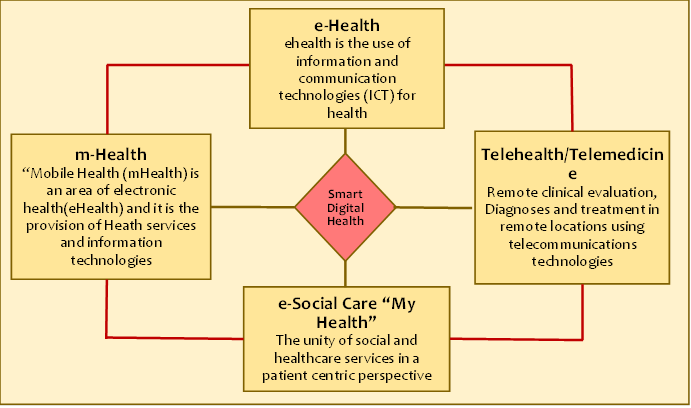
challenges through remote services enabled by technology. Figure 1 illustrates
the range of technologies within the smart health domain that support the
delivery of patient-centered healthcare services. In this framework,
information is shared and utilized across stakeholders and sectors, emphasizing
that smart digital solutions extend beyond technology alone and require
organizational change. For this reason, technical solutions in this domain are
collectively referred to as smart digital health, as they enable patients and
ecosystem stakeholders to share relevant data (Nordic Innovation, 2018).
Figure 1.
Data and information sharing across solutions and sectors
Source: Nordic Innovation. (2018).
A Nordic story about smart digital health.
Connected
Health
Connected health is defined as a
socio-technical model for managing and delivering healthcare through the use of
technology to enable remote healthcare services. It also serves as an umbrella
term encompassing various forms of remote healthcare, including telemedicine,
mobile health, digital health, and e-health services (Nordic Innovation, 2018).
Mobile health (mHealth) refers to the delivery of healthcare services via
mobile devices through dedicated applications. These services include patient
management functions such as appointment bookings, reminders, discharges (MacKinnon & Brittain,
2020), and
referrals, delivered through multiple channels including the internet and
mobile devices. mHealth also integrates data from wearable devices,
particularly those related to fitness and health monitoring. Several successful
applications in the Nordic region demonstrate innovative approaches to patient
monitoring (Chauhan
et al., 2025),
including the Coalalife application in Sweden for cardiovascular data collection,
the Kaiku Health application in Finland for smart patient monitoring (Wettstein et al., 2024), and the Docrates Cancer
Center in Finland, which provides specialized oncology services.
Telehealth
or telemedicine
Telemedicine, also referred to as
telehealth or e-health, enables healthcare professionals to evaluate, diagnose,
and treat patients in remote locations using communication technologies. This
approach allows patients in geographically isolated areas to access medical
expertise efficiently without the need for travel (Vudathaneni et al., 2024).
Telehealth solutions improve patient satisfaction while reducing the demand for
hospital resources such as staff, beds, and equipment (Haleem et al., 2021).
Examples of successful applications include the OpenTeleHealth platform in
Denmark for remote patient monitoring, the Kanta system in Finland for patient
data management in telehealth, and the Kvikna application in Iceland for
information management.
Electronic
social care
Electronic social care integrates
social services with healthcare by providing reliable information related to
patient well-being and enabling its continued use over time. Innovative models
such as population health management have emerged through the integration of
social and healthcare data into unified data warehouses (Knezevic et al.,
2025), where digital analytics and artificial intelligence can be applied.
Examples of successful applications include the use of Coalalife in Sweden to
provide aggregated data to general practitioners, RoomMate in Norway for secure
image information sharing (Nwokedi et al., 2024), and Stiki Solutions in
Iceland for securing healthcare system data (Nordic Innovation, 2018).
Different
components of digital health
The COVID-19 pandemic has accelerated
the development of digital health, transforming healthcare delivery through
online symptom screening, patient-facing tools, remote patient monitoring, and
telehealth services. This transformation has created significant opportunities
in the healthcare market, with venture capital funding in digital health more
than doubling compared to 2019 (Omboni et al., 2022), largely due to the
increased adoption of consumer-oriented digital health technologies (Khan &
Duncan, 2025). Key components of digital health include the management of large
and complex datasets through advanced analytics, the use of cloud computing for
scalable healthcare infrastructure, patient-centered healthcare delivery models
such as connected health (Peek et al., 2023; Cotton & Patel, 2019), the
application of e-health systems across healthcare functions, active patient
engagement through e-patients, and the use of gamification technologies in
health and fitness applications (WHO, 2025):
· The use of electronic
processes and information technology (ICT) across the full range of functions,
affecting health and care, in other words, the use of e-health which symbolizes
the field of medical informatics, which uses the Internet and related technologies
to organize and distribute health services and information.
· E-Patients: Patients who
participate fully electronically in their health and care are referred to as
e-Patients, and they know everything there is to know about their health and
health care, and may be involved in their own health and care, as well as the
health and care of the people they care for.
· Using game
application technology : incorporating game-like elements has become a familiar
and effective strategy in health and fitness applications. It boosts user
engagement and encourages individuals to exercise more regularly while making
lasting, positive adjustments to their daily habits—ultimately leading to
meaningful improvements in their overall health.
The global digital health market is
driven by increasing demand for mobile health applications, remote patient
monitoring services, and the widespread adoption of smartphones and
health-related applications worldwide (Pandey,
2025). These trends have contributed to the integration of
artificial intelligence, mobile platforms, and automated electronic health
records, supporting the development of smart healthcare systems that enhance
service quality and promote sustainable development (Ghadi et al., 2025). However,
concerns related to cybersecurity and financial constraints continue to pose
challenges to market growth (Alzghaibi, 2025).
Levels of health care development
Digital health is described as the
integration of electronic information and communication technologies into
healthcare processes to improve overall health and well-being. The rapid
adoption of emerging technologies such as wearable devices, mHealth applications,
ingestible sensors (Bahadori et al., 2025), and artificial intelligence has
provided strong momentum for the growth of the smart digital health market (Ronquillo
et al., 2025(.
At the
global level
Digitization has significantly
transformed the global healthcare industry, resulting in increased adoption of
mobile health services, driven primarily by widespread smartphone usage and the
impact of the COVID-19 pandemic (Rawal, 2025). Consequently, demand for smart
healthcare products has expanded, with the fitness and digital well-being
sector capturing the largest market share and generating revenues of €85.53
billion in 2024 (MarketsandMarkets, 2025). The global digital healthcare market
is projected to reach €177.10 billion by the end of 2024, with a compound
annual growth rate of 9.23% between 2024 and 2028, leading to a projected
market size of €252.10 billion by 2028 and an average revenue per user of
€54.88 (Grand View Research, n.d; Statista, 2025a).
Digital health encompasses the digital
transformation of healthcare systems through the integration of software,
hardware, and services. Key technologies include mHealth applications, wearable
devices, electronic health records, electronic medical records, telemedicine,
telehealth, and personalized medicine (MarketsandMarkets, n.d; Pandey, 2025). Demographic changes, disease
prevalence, rising healthcare costs, and inequalities in access to care have
increased the need for technological innovation, while epidemics and pandemics
have further highlighted the importance of digital health solutions. These
factors are expected to continue driving market growth, with digital health
revenues projected to reach €252.05 billion by 2028 (WHO, 2021; Grand View
Research, n.d.).
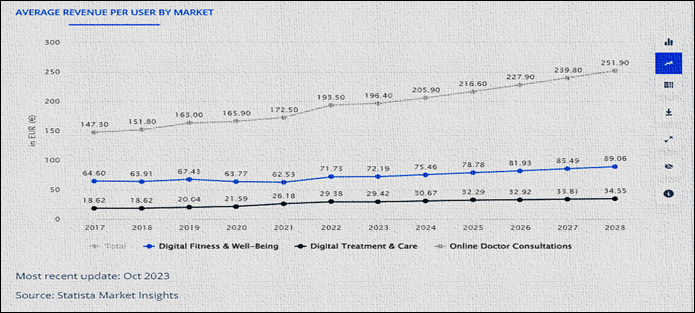
Figure 2
Average digital healthcare
market revenue per user
Source: From Statista. (2023, October). Average
revenue per user (ARPU) in digital health markets worldwide from 2017 to 2028,
by segment [Chart].
https://www.statista.com/outlook/hmo/digital-health/digital-fitness-well-being/worldwide.
Reprinted with permission.
The digital health
market, encompassing multiple intersections between healthcare and digital
technologies, has experienced substantial growth, creating significant
opportunities for businesses worldwide. Market data indicate that the average
revenue per user reaches €205.90 for telemedicine consultations, €75.46 for
fitness and physical and digital health services, and €30.29 for digital
treatment and care solutions. These figures highlight the differentiated
economic performance across digital health segments and reflect the increasing
demand for technology-enabled healthcare services. Digital solutions have
played a pivotal role in reshaping electronic health by enhancing the value
delivered to traditional healthcare systems. Consequently, redefining the
structure and functional scope of digital health has become essential to ensure
its effective integration and activation for end users. Overall, the continued
expansion of digital health is closely linked to a range of external
technological, economic, and social factors that collectively influence its
growth dynamics (Navallo et al., 2024; Rawal, 2025).
The digital health market has witnessed
significant global growth driven by increased adoption of digital technologies,
heightened health awareness among consumers, and rising healthcare expenditures
in exchange for the convenience offered by online health services (IMARC Group,
n.d.). One of the most influential factors has been the impact of the COVID-19
crisis, which contributed to an estimated growth increase of 2.3%, in addition
to several market-specific drivers (Statista, 2025a).
Customer choices and
preferences. Consumers increasingly seek digital fitness and well-being
solutions to monitor and improve their health, driving demand for wearable
devices and health-tracking applications (Chandrasekaran et
al., 2025). Online medical consultations have also gained popularity
among individuals seeking timely and accessible professional advice (Tila,
2025).
Changes in market
trends. A growing global trend involves the use of health and fitness
applications to track daily activities and monitor health indicators. Digital
treatment platforms are also attracting increasing interest by enabling
patients to access personalized treatment plans and medication management
services online (Curry, 2026).
Local contextual conditions.
Country-specific conditions play a crucial role in shaping digital health
market development. The widespread adoption of smartphones, combined with
governmental support for digital healthcare initiatives (Ahmed et
al., 2025), has accelerated the expansion of telehealth platforms,
particularly in regions with limited access to traditional healthcare
facilities (Sylla et al., 2025).
Macroeconomic
factors. Market growth is further influenced by macroeconomic variables such as
technological advancement, regulatory support, and investment in healthcare
infrastructure (Rabbani et al., 2025).
Additionally, the global increase in chronic diseases and aging populations has
amplified demand for digital healthcare solutions.
A
healthcare system built on a fully digital ecosystem can generate multiple
societal benefits. Empirical studies demonstrate the value of digital tools in
disease surveillance, screening programs, awareness campaigns (Erku et
al., 2023), behavioral health interventions delivered through social
media, and digital health literacy. Evidence increasingly confirms that digital
healthcare solutions support prevention strategies, reduce healthcare demand,
and contribute to healthier societies by integrating medical and behavioral
knowledge (Qiu et al., 2025).
At the
Singapore level
Singapore provides
comprehensive healthcare coverage through multiple layers of care. Among ASEAN
countries, it records the highest per capita healthcare expenditure, which is
expected to increase faster than GDP due to population aging and demographic shifts
(Navallo et al., 2024; Gill et al., 2024). According to recent statistics:
·
Singapore
ranked first among 104 countries in the Health Component of the Legatum
Prosperity Index 2023, reflecting population health status and access to
services.
·
Singapore
General Hospital ranked ninth globally in the 2023 World Hospital Rankings
conducted by Newsweek and Statista.
·
National
healthcare expenditure is projected to reach US$43 billion by 2030.
·
Healthcare
spending is expected to represent 5.9% of GDP, potentially rising to 9.0% by
the end of the decade.
According to an
analysis of the top 50 HealthTech companies in Southeast Asia for 2023–2024,
Singapore accounted for 66% of leading firms, while Malaysia’s share increased
from 2% in 2021 to 6% in 2023 (Mendoza, 2025).
In 2021, Singapore’s
imports of medical equipment declined by 5.0% year-on-year, with U.S. suppliers
holding a 24% market share and more than 70% of imports re-exported (U.S.
Department of Commerce, International Trade Administration, 2025). From 2023 onward,
imports and domestic production are expected to rise due to economic recovery,
demographic aging, chronic disease prevalence, technological innovation, and
increased health awareness (Nexdigm, 2024). These trends are also accelerating
a shift from hospital-centric care toward outpatient and community-based
models, creating strategic opportunities for remote care and patient monitoring
initiatives (Theseira, 2025).
Singapore’s national
healthcare spending is projected to reach S$59 billion by 2030, supported by
targeted investments in healthcare infrastructure, subsidies, and digital
health innovation Priority areas include telemedicine, remote care, artificial
intelligence, cybersecurity for electronic health records, data sharing,
preventive care, and personal health management (Ministry of Health Singapore,
2022).
Levels of adoption of smart healthcare solutions
The healthcare
ecosystem has undergone a paradigm shift in service delivery and consumption,
increasing demand for decentralized, cost-effective, and high-quality care
models. Digital health supports key objectives such as prevention-oriented
care, improved access, cost reduction, quality enhancement, and efficient
resource utilization. Mobile applications, wearable devices, and ingestible
sensors have become essential tools for diagnosis and patient monitoring
(Pandey, 2025).
The adoption of
telemedicine and smart medical devices has expanded significantly. The value of
IoT in healthcare is projected to exceed US$534 billion by 2025, while wearable
device adoption reached approximately 515 million units by the end of 2022. Artificial
intelligence applications in healthcare are expected to generate annual savings
of up to US$150 billion by 2026, with big data analytics reducing treatment
costs by approximately 25% (Deb, 2025).
At the
global level
The global smart
healthcare market reached a value of US$184 billion in 2022 and is projected to
grow to approximately US$541 billion by 2032, with a compound annual growth
rate of 15.7% (Grand View Research, n.d.). Artificial intelligence-based
diagnostics have achieved accuracy rates of up to 90% for certain medical
conditions, telemedicine usage increased globally by 80% in the past year, and
over 60% of hospitals worldwide have implemented IoT technologies (Elagina,
2025). Approximately 85% of healthcare institutions now use big data analytics
for population health management, contributing to healthcare cost savings of up
to 30% for providers and patients (Grand View Research, n.d.).
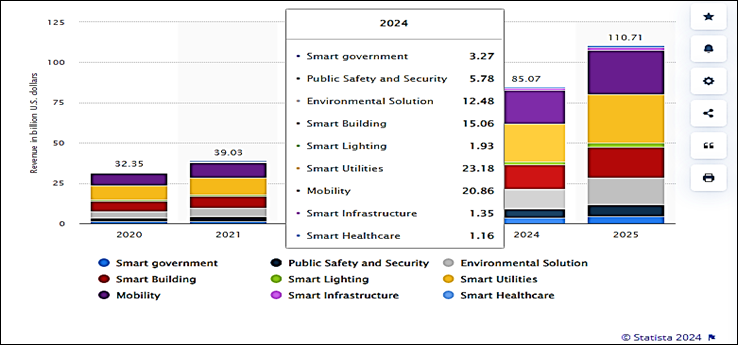
Figure
3
Smart
city operating revenues worldwide 2020-2025, by industry

Source: Elagina,
D. (2025). Projected revenue generated by startups in the global smart city
market from 2020 to 2025, by industry (in billion U.S. dollars) [Chart].
https://www.statista.com/statistics/1231502/smart-city-startup-revenue-by-industry.
Reprinted with permission.
The projected global
revenues of smart city utility technology startups were expected to reach
US$10.75 billion in 2021, increasing to approximately US$30 billion by 2025.
Within this context, the smart digital health sector reached revenues of
approximately US$1.16 billion in early 2024 (Elagina, 2025).
At the
Singapore level
The Singapore
government’s spending on health, estimated at approximately 2% of GDP, is among
the lowest compared to other high-income countries. Nevertheless, Singapore
maintains a high standard of health and healthcare outcomes. Life expectancy at
birth reaches around 83 years, and the country records one of the lowest infant
mortality rates globally (Report Ocean, 2025). In addition, the increasing
importance and widespread adoption of government-approved digital fitness and
wellbeing solutions, supported by a robust healthcare infrastructure and strong
governmental backing, have positioned Singapore as a leading hub for innovation
and investment in digital health. Accordingly, the digital health market in
Singapore is expected to experience substantial growth (Statista, 2025b).
Revenues in the
Singaporean digital health market are projected to reach approximately USD
790.10 million by the end of the current year, reflecting significant growth
opportunities for the sector. The market is forecast to expand at a compound
annual growth rate of 14.16% between 2024 and 2028, reaching an estimated
market size of USD 1,342.00 million by 2028 (Taylor, 2025). Furthermore, the
average revenue per user (ARPU) is expected to reach USD 142.30, with digital
treatment and care accounting for the largest share of revenues, estimated at
USD 438.50 million at the beginning of 2024 (Mendoza, 2025).
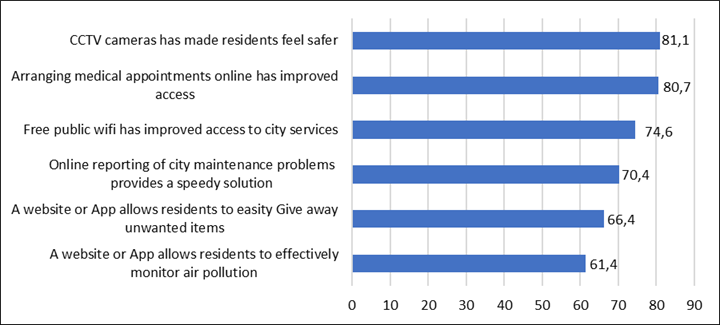
Figure 4
Health and safety index
score in smart cities in Singapore
Source:
From Institute for Management Development.
(2024). IMD Smart City Index 2024. IMD World Competitiveness Center.
https://www.coit.es/sites/default/files/imd_-smartcityindex-2024-full-report.pdf.
Healthcare in
Singapore is primarily based on the principle of individual responsibility
combined with affordable healthcare for all citizens. Government subsidies
support investments in smart city infrastructure (Ministry of Health Singapore,
2024), including sensory camera surveillance systems (81.1%) and remote medical
diagnostic systems (60.7%). In addition, individual private savings and a set
of insurance schemes collectively known as the “3Ms” (Medisave, MediShield, and
MediFund) play a central role in financing healthcare coverage for citizens.
Moreover, the adoption of telemedicine and remote patient monitoring has
contributed to a reduction of approximately 60% in hospital readmissions
(Tan et al., 2023).
Conclusion
Smart healthcare,
driven by rapid technological advancements and artificial intelligence, has
profoundly transformed the healthcare industry by offering innovative solutions
and improving patient outcomes. Recent statistics indicate a significant
increase in the adoption of smart healthcare systems, particularly in
telemedicine, wearable devices, and AI-based diagnostic tools, with
telemedicine representing one of the fastest-growing segments in the smart
healthcare market.
Following the
outbreak of the COVID-19 pandemic, the adoption of telemedicine accelerated
considerably, as healthcare professionals increasingly relied on virtual care
delivery to maintain effective communication with patients under conditions of
social distancing. These developments have not only enhanced the quality of
patient care but have also improved resource allocation and reduced overall
healthcare costs.
Globally, the smart
healthcare market reached an estimated value of USD 184 billion in 2022 and is
projected to grow to approximately USD 541 billion by 2032, at a compound
annual growth rate of 15.7% (Pandey, 2025). The adoption
of smart technologies has yielded notable outcomes, with artificial
intelligence-based diagnostics achieving accuracy rates of up to 90% for
certain medical conditions. Additionally, global telemedicine usage increased
by nearly 80% in recent years, while more than 60% of hospitals worldwide have
implemented Internet of Things (IoT) devices for diverse healthcare
applications.
Furthermore,
approximately 85% of healthcare institutions now employ big data analytics to
support population health management, contributing to increased patient
awareness. Nearly 70% of patients express willingness to use smart healthcare
solutions to improve health management, resulting in healthcare cost savings of
up to 30% for both patients and providers. Revenues generated by emerging
companies in the smart healthcare sector reached approximately USD 1.16 billion
by early 2024 (Elagina, 2025).
At the national
level, Singapore has emerged as a leading center for innovation and investment
in digital health. Life expectancy has reached approximately 83 years, infant
mortality rates remain among the lowest worldwide, and hospital readmissions
have declined by nearly 60%. These outcomes are attributed to the widespread
adoption of government-approved digital fitness and wellness solutions, a
strong healthcare infrastructure, and sustained government support, including
investments in smart cities, surveillance systems, remote medical diagnostics,
and comprehensive insurance schemes. National health expenditure in Singapore
is projected to reach SGD 59 billion by 2030, with approximately SGD 5.6
billion allocated to address short- and long-term infrastructure challenges,
healthcare costs, and population aging.
References
Abdel, L. (2024). Security and Privacy
in Digital Healthcare Systems: Challenges and Mitigation Strategies. Abhigyan, 42, 23–31. https://journals.sagepub.com/doi/pdf/10.1177/09702385241233073
Ahmed,
M. M., Okesanya, O. J., Olaleke, N. O., Adigun, O. A., Adebayo, U. O., Oso, T.
A., Eshun, G., & Lucero-Prisno, D. E., III. (2025). Integrating digital health
innovations to achieve universal health coverage: Promoting health outcomes and
quality through global public health equity. Healthcare, 13(9), 1060. https://doi.org/10.3390/healthcare13091060
Alami,
H., Gagnon, M. P., & Fortin, J. P. (2017). Digital health and the challenge
of health systems transformation. mHealth, 3(8), 31. https://doi.org/10.21037/mhealth.2017.07.02
Alzghaibi,
H. (2025). Nurses’ perspectives on AI-enabled wearable health technologies:
Opportunities and challenges in clinical practice. BMC Nursing 24, 799. https://doi.org/10.1186/s12912-025-03343-y
Apablaza,
j., & Cano, S. (2022). Affective Computing from Digital Health: A
literature review: In V. Agredo Delgado, P. H. Ruiz., & Collazos, C. A. (Eds.), Proceedings of the 6th
Workshop on ICTS for Improving Patients Rehabilitation Research Techniques
(REHAB 2022) (pp.6–14). CEUR
Workshop Proceedings. http://ceur-ws.org/Vol-3446/Paper2.pdf
Bahadori,
S., Buckle, P., Soukup Ascensao, T., Ghafur, S., & Kierkegaard, P. (2025).
Evolving digital health technologies: Aligning with and enhancing the National
Institute for Health and Care Excellence evidence standards framework. JMIR
mHealth and uHealth, 13, e67435. https://doi.org/10.2196/67435
Chandrasekaran, R., Sadiq, T. M., & Moustakas, E. (2025). Usage
trends and data sharing practices of healthcare wearable devices among US
adults: Cross‑sectional study. Journal of Medical Internet Research,
27, e63879. https://doi.org/10.2196/63879
Chauhan,
G.K., Vavken, P., & Jacob, C. (2025). Mobile apps and wearable devices for
cardiovascular health: Narrative review. JMIR mHealth and uHealth, 13,
e65782. https://doi.org/10.2196/65782
Cotton,
V., & Patel, M. S. (2019). Gamification use and design in popular health and fitness
mobile applications. American Journal of Health Promotion, 33(3),
448–451.
https://doi.org/10.1177/0890117118790394
Curry,
D. (2026). Health app revenue and usage statistics, Business of Apps. https://www.businessofapps.com/data/health-app-market
Deb,
T. (2025, January 13). Smart healthcare statistics 2025 by technology,
healthcare, AI. Market.us. https://media.market.us/smart-healthcare-statistics/
Elagina,
D. (2025). Projected revenue generated by startups in the global smart city
market from 2020 to 2025, by industry. Statista. https://www.statista.com/statistics/1231502/smart-city-startup-revenue-by-industry/
Erku,
D., Khatri, R., Endalamaw, A., Wolka, E., Nigatu, F., Zewdie, A., & Assefa,
Y. (2023). Digital health interventions to improve access to and quality of
primary health care : A scoping review. International Journal of
Environmental Research and Public Health, 20(19), 6854. https://doi.org/10.3390/ijerph20196854
Furlepa,
K., Tenderenda, A., Kozłowski, R., Marczak, M., Wierzba, W., & Śliwczyński,
A. (2022). Recommendations for the development of telemedicine in connected
health models and smart digital health frameworks. International Journal of
Environmental Research and Public Health, 19(3), 1221. https://doi.org/10.3390/ijerph19031221
Ghadi,
Y. Y., Shah, S. F. A., Waheed, W., Mazhar, T., Ahmad, W., Saeed, M. M., &
Hamam, H.
(2025). Integration of wearable technology and artificial intelligence in
digital health for remote patient care. Journal of Cloud Computing, 14,
39. https://doi.org/10.1186/s13677-025-00759-4
Gill,
J., Chávez, D., Main, C., Miracolo, A., Fontrier, A.-M., & Kanavos, P.
(2024). Sustainable healthcare financing for SDG3 in ASEAN-6. London
School of Economics and Political Science. https://www.usasean.org/sites/default/files/2024-03/Sustainable%20Healthcare%20Financing%20for%20SDG3%20in%20ASEAN-6%20Report.pdf
Grand
View Research. (n.d.). Smart Healthcare Market (2025 - 2030), share &
industry report. https://www.grandviewresearch.com/industry-analysis/smart-healthcare-market
Haleem,
A., Javaid, M., Singh, R. P., & Suman, R. (2021). Telemedicine for
healthcare: Capabilities, features, barriers, and applications. Sensors
International, 2, 100117. https://doi.org/10.1016/j.sintl.2021.100117
Hu,
E., Wang, H., Yao, J., Liao, M., & Chen, W. (2026). Impact of digital
health interventions on quality of life and mental health in older adults with
chronic diseases: A systematic review and meta-analysis. Frontiers in Aging,
6, 1737277. https://doi.org/10.3389/fragi.2025.1737277
IMARC
Group. (n.d). Digital health market: Global industry trends, share &
analysis report, 2033. https://www.imarcgroup.com/digital-health-market
IMD. (2024). IMD Smart City Index
2024. IMD World Competitiveness Center. [Report] https://www.coit.es/sites/default/files/imd_-smartcityindex-2024-full-report.pdf
Iyawa,
G. E., Herselman, M., & Botha, A. (2019). Digital health innovation
ecosystems: Identifying key participants, benefits, challenges, and guidelines
for the Namibian context. International Journal of Reliable and Quality
E-Healthcare, 8(2), 1–14. https://doi.org/10.4018/IJRQEH.2019040101
Keesara,
S., Jonas, A., & Schulman, K. (2020). Covid-19 and health care’s digital
revolution. New England Journal of Medicine, 382(23), e82. https://doi.org/10.1056/NEJMp2005835
Khan,
A., & Duncan, D. (2025). Remote patient monitoring applications in
healthcare: Lessons from COVID-19 and beyond. Electronics, 14(15), 3084.
https://doi.org/10.3390/electronics14153084
Knezevic,
T., Honap, S., Matic, R., Markovic, S., & Peyrin-Biroulet, L. (2025).
Building a healthcare data warehouse: Considerations, opportunities, and
challenges. Frontiers in Digital Health, 7, 1691142. https://doi.org/10.3389/fdgth.2025.1691142
MacKinnon,
G. E., & Brittain, E. L. (2020). Mobile health technologies in
cardiopulmonary disease. Chest, 157(3), 654–664. https://doi.org/10.1016/j.chest.2019.10.015
Malasinghe,
L. P., Ramzan, N., & Dahal, K. (2019). Remote patient monitoring: A
comprehensive study. Journal of Ambient Intelligence and Humanized
Computing, 10(1), 57–76. https://doi.org/10.1007/s12652-017-0598-x
MarketsandMarkets.
(2025). Digital health market size, Growth, Share & Trends Analysis.
https://www.marketsandmarkets.com/Market-Reports/digital-health-market-45458752.html?utm_source=chatgpt.com
Mendoza,
J. (2025, May 6). Healthcare in Southeast
Asia - statistics & facts [Topic overview]. Statista. https://www.statista.com/topics/12530/healthcare-in-southeast-asia/?referrer=grok.com#topicOverview
Ministry
of Health Singapore. (2022, February 14). Projected annual healthcare
spending for the next decade. Government of Singapore. https://www.moh.gov.sg/newsroom/projected-annual-healthcare-spending-for-next-decade
Ministry
of Health Singapore. (2024, October 26). Healthcare financing and the 3 Ms:
Government subsidies, MediSave, MediShield Life, and MediFund. Government
of Singapore. https://www.moh.gov.sg/managing-expenses/keeping-healthcare-affordable/managing-medical-bills/
Navallo,
K., Detros, K., & ASEAN-Japan Centre. (2024). Assessing digital health
adoption in ASEAN. https://www.asean.or.jp/main-site/wp-content/uploads/2024/07/Assessing-Digital-Health-Adoption-in-ASEAN.pdf
Nexdigm.
(2024). Singapore medical devices industry report: Market analysis, drivers,
trends, and forecast. Nexdigm. https://www.nexdigm.com/market-research/report-store/singapore-medical-devices-market-report
Nordic
Innovation. (2018). A Nordic story about smart digital health. Nordic
Council of Ministers. http://norden.diva-portal.org/smash/get/diva2:1297054/fulltext01
Nwokedi,
C. N., Soyege, O. S., Balogu, O. D., Mustapha, A. Y., Tomoh, B. O., Mbata, A.
O., & Iguma, D. R. (2024). Big data analytics and artificial intelligence
in healthcare: Transforming diagnostics, treatment, and disease prevention. International
Journal of Scientific Research in Science and Technology, 11(6), 1035–1060.
https://doi.org/10.32628/IJSRST25121245
Olu,
O., Muneene, D., Bataringaya, J. E., Nahimana, M.‑R., Ba, H., Turgeon, Y.,
Karamagi, H. C., & Dovlo, D. (2019). How can digital health technologies
contribute to sustainable attainment of universal health coverage in Africa? A
perspective. Frontiers in Public Health, 7, 341. https://doi.org/10.3389/fpubh.2019.00341
Omboni,
S., Padwal, R. S., Alessa, T., Benczúr, B., Green, B. B., Hubbard, I., Kario,
K., Khan, N. A., Konradi, A., Logan, A. G., Lu, Y., Mars, M., McManus, R. J.,
Melville, S., Neumann, C. L., Parati, G., Renna, N. F., Ryvlin, P., Saner, H.,
Schutte, A. E., & Wang, J. (2022). The worldwide impact of telemedicine
during COVID-19: Current evidence and recommendations for the future. Connect
Health, 1, 7–35. https://doi.org/10.20517/ch.2021.03
Organisation
for Economic Co-operation and Development. (2019). Health in the 21st century: Putting data to work for
stronger health systems. OECD Publishing. https://www.oecd.org/en/publications/health-in-the-21st-century_e3b23f8e-en.html
Pandey,
D. (2025). Digital health market size, share, and trends analysis report.
Precedence Research. https://www.precedenceresearch.com/digital-health-market
Peek,
N., Sujan, M., & Scott, P. (2023). Digital health and care: Emerging from
pandemic times. BMJ Health & Care Informatics, 30, e100861. https://doi.org/10.1136/bmjhci-2023-100861
Qiu,
C. S., Lunova, T., Greenfield, G., Kerr, G., Ergüven, Ö., Beaney, T., Hayhoe,
B., Mayer, E., Majeed, A., & Neves, A. L. (2025). Determinants of digital
health literacy: International cross-sectional study. Journal of Medical
Internet Research, 27, e66631. https://doi.org/10.2196/66631
Rabbani,
M. G., Alam, A., & Prybutok, V. R. (2025). Digital Health Transformation
Through Telemedicine (2020–2025): Barriers, Facilitators, and Clinical Outcomes
-- A Systematic Review and Meta-Analysis. Encyclopedia, 5(4),
206. https://doi.org/10.3390/encyclopedia5040206
Rawal,
J. (2025). Digital health market size, share & industry analysis,
Fortune Business Insights [Report]. https://www.fortunebusinessinsights.com/industry-reports/digital-health-market-100227
Report
Ocean. (2025, March 19). Singapore
digital health market forecast to 2029, innovations, growth drivers, and future
opportunities. Taiwan
News. https://www.taiwannews.com.tw/news/6063234
Ronquillo,
Y., Meyers, A., & Korvek, S. J. (2025). Digital health. In StatPearls
[Internet]. StatPearls Publishing. https://www.ncbi.nlm.nih.gov/books/NBK470260/
Rowlands,
D. (2019). What is digital health? And why does it matter? White paper,
Digital Health Workforce Academy / Australasian Institute of Digital Health. https://digitalhealth.org.au/wp-content/uploads/2020/02/DHWA_WHITEPAPER_2019.pdf
Statista.
(2023, October). Average revenue per user (ARPU) in digital health markets
worldwide from 2017 to 2028, by segment (in euros) [Chart]. https://www.statista.com/outlook/hmo/digital-health/digital-fitness-well-being/worldwide
Statista. (2025a, December 17). Digital
health – statistics & facts. Statista. https://www.statista.com/topics/2409/digital-health/
Statista.
(2025b). Digital health - worldwide. https://www.statista.com/outlook/hmo/digital-health/worldwide
Sylla,
B., Ouedraogo, I., & Diallo, G. (2025). 25 years of digital health toward
universal health coverage in low- and middle-income countries: Rapid systematic
review. Journal of Medical Internet Research, 27, e59042. https://doi.org/10.2196/59042
Tan,
T. F., Thirunavukarasu, A. J., Jin, L., Lim, J., Poh, S., Teo, Z. L., Ang, M.,
Chan, R. V. P., Ong, J., Turner, A., Karlström, J., Wong, T. Y., Stern, J.,
& Ting, D. S.‑W. (2023). Artificial intelligence and digital health in
global eye health: Opportunities and challenges. The Lancet Global Health,
11(9), e1432‑e1443. https://doi.org/10.1016/S2214-109X(23)00323-6
Taylor, P. (2025). Smart city health and
safety technologies index score in Singapore in 2024, by type [Graph].
Statista. https://www.statista.com/statistics/1410492/singapore-smart-city-health-and-safety-technologies-index/
Theseira,
K. (2025). Healthcare
sector overview: Singapore. International Trade Administration (U.S.
Department of Commerce). https://www.trade.gov/country-commercial-guides/singapore-healthcare
Tila,
C. (2025). Number of digital health activity days Singapore 2023, by
generation. Statista. https://www.statista.com/statistics/1608296/singapore-digital-health-activity-days-by-generation/
U.S.
Department of Commerce, International Trade Administration. (2025, August 21). Singapore
– healthcare: Country commercial guide. https://www.trade.gov/country-commercial-guides/singapore-healthcare
Vudathaneni,
V. K. P., Lanke, R. B., Mudaliyar, M. C., Movva, K. V., Kalluri, L. M., &
Boyapati, R. (2024). The impact of telemedicine and remote patient monitoring
on healthcare delivery: A comprehensive evaluation. Cureus, 16(3),
e55534. https://doi.org/10.7759/cureus.55534
Wettstein,
R., Sedaghat-Hamedani, F., Heinze, O., Amr, A., Reich, C., Betz, T.,
Kayvanpour, E., Merzweiler, A., Büsch, C., Mohr, I., Friedmann-Bette, B., Frey,
N., Dugas, M., & Meder, B. (2024). A remote patient monitoring system with
feedback mechanisms using a smartwatch: Concept, implementation, and evaluation
based on the activeDCM randomized controlled trial. JMIR mHealth and
uHealth, 12, e58441. https://doi.org/10.2196/58441
World
Health Organization. (2021). Global strategy on digital health 2020–2025: Accelerating
the implementation. WHO Press. https://www.who.int/publications/i/item/9789240020924
World
Health Organization. (2025). eHealth: Definition and applications. WHO. https://www.emro.who.int/health-topics/ehealth
Zainal,
A., Abdul Aziz, N. F., Ahmad, N. A., Abdul Razak, F. H., Razali, F., Azmi, N.
H., & Koyou, H. L. (2023). Usability measures used to enhance user
experience in using digital health technology among elderly: A systematic
review. Bulletin of Electrical Engineering and Informatics, 12(3),
1825–1832. https://doi.org/10.11591/eei.v12i3.4773